Multidimensional BIM: Implementing 3D to 7D for Efficient and Sustainable Project Management

Introduction
The construction industry is undergoing a transformation driven by the need to increase efficiency, reduce environmental impacts, and improve the management of built assets. In this context, Building Information Modeling (BIM) has become a key methodology to integrate information, processes, and people throughout the entire project lifecycle.
The multidimensional BIM approach—from 3D to 7D—enables a shift from traditional execution-focused delivery to comprehensive management aimed at sustainability, control, and efficient operations, especially relevant for residential projects and institutional/office infrastructure.

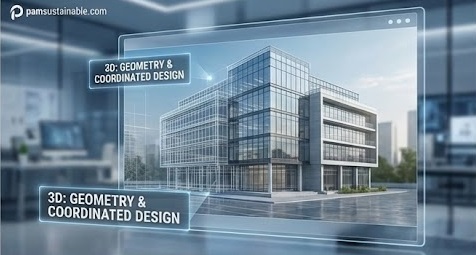
BIM 3D: Modeling and Coordination
BIM 3D is the foundation of the digital model. It integrates architecture, structure, and MEP systems in a coordinated environment where each element is an intelligent object with associated information. Early coordination helps detect clashes, improve design quality, and reduce on-site errors.
In residential projects, BIM 3D supports repetition and standardization; in institutional buildings, it improves coordination of complex systems and technical areas.
BIM 4D: Schedule Planning and Time Control
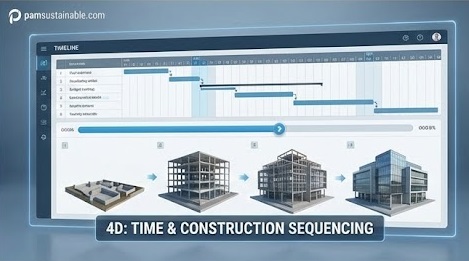
BIM 4D adds the time dimension by linking the model to the construction schedule. This enables simulation of construction sequences, visualization of progress, and early detection of planning conflicts.
BIM 4D improves decision-making, reduces delays, and strengthens physical progress monitoring—directly supporting efficient project execution.
BIM 5D: Cost Management and Financial Control
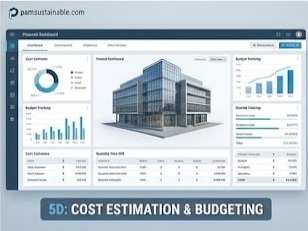
BIM 5D integrates costs and budgets into the digital model. Quantities can be extracted directly from the model, enabling dynamic estimating and immediate cost impact assessment when design or scope changes occur.
This dimension increases transparency, traceability, and financial control throughout the construction process.
BIM 6D: Sustainability and Environmental Performance
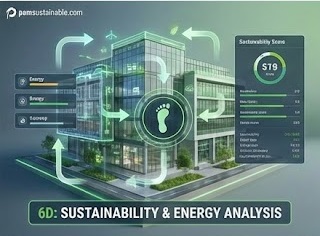
BIM 6D incorporates sustainability and performance data. It enables analysis of energy consumption, material efficiency, system lifespan, and embodied carbon.
For residential projects, BIM 6D supports more efficient and comfortable homes. For offices and institutions, it helps optimize systems, reduce operating costs, and support green certifications. This dimension connects directly to energy optimization, circular economy strategies, and emission reduction.
BIM 7D: Operations and Maintenance
BIM 7D extends the model into operations and maintenance. The building becomes a digital twin that stores key information for asset management, preventive maintenance, and rehabilitation planning.
BIM 7D enables a shift from reactive maintenance to planned maintenance, improving asset life and reducing long-term costs.

Want to implement BIM 3D–7D in your next project?
PAM Sustainable can support BIM standards, coordination, 4D/5D control, and 6D/7D strategy for efficient and sustainable delivery.
Request consultation